AI Embryo Selection IVF: Machine Learning Success at Bliss Fertility
- Jul 10
- 8 min read
Updated: Jul 20

The journey of In Vitro Fertilisation (IVF) has always been a delicate balancing act between advanced science and the subtle rhythms of human biology. For decades, the final, most critical decision in an IVF cycle, choosing which specific embryo to transfer into the maternal uterus, rested entirely on the human eye. Embryologists would sit at microscopes, evaluate the shape and symmetry of developing cells, and assign a visual grade based on standard classification models.
While this traditional method has helped millions of families realise their dreams, it has inherently encountered the limits of static human observation. A standard evaluation offers only a fleeting snapshot of a highly dynamic biological process. If an embryo undergoes an abnormal cellular division pattern in the middle of the night, it may look perfectly normal during a brief morning check.
As we progress through 2026, a monumental paradigm shift has established itself across world-class laboratories. The integration of artificial intelligence in fertility treatments has fundamentally transformed how we evaluate early life. By utilising deep-learning algorithms paired with continuous time-lapse video tracking, reproductive medicine has entered a new era of unprecedented objectivity.
At Bliss Fertility Hospital, we have integrated this scientific breakthrough into our core laboratory workflows. By choosing an analytical approach that replaces subjective grading with data-driven predictive precision, we are empowering couples with higher success rates, minimised cycle counts, and absolute clarity at every single stage of their treatment.
The Limitations of Traditional Grading: Moving Past the Snapshot
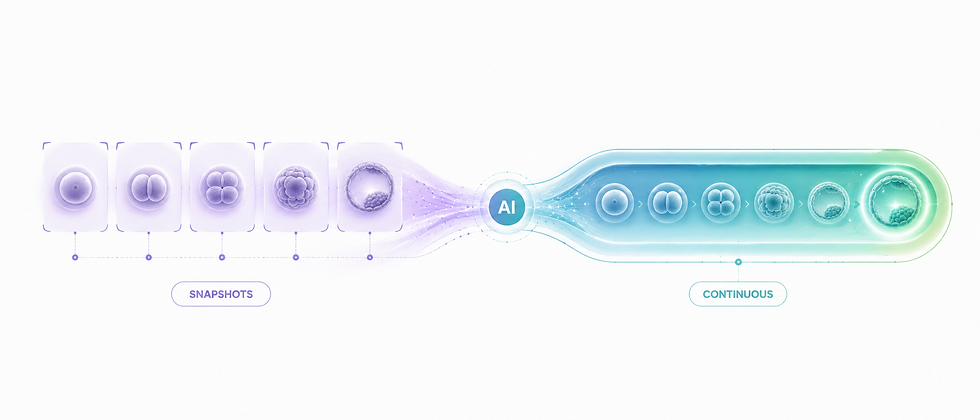
To appreciate why AI embryo selection IVF models represent such a profound evolutionary leap, it is first necessary to examine the traditional methods that preceded them. For years, embryo selection relied on manual morphological grading system models, such as the Gardner system. This method categorises blastocysts (day-five or day-six embryos) based on three distinct structural parameters:
Expansion Status: The overall size of the embryo cavity and the degree to which it has thinned the outer protective shell (the zona pellucida).
Inner Cell Mass (ICM) Quality: The tightly packed cluster of cells that will eventually develop into the fetus itself.
Trophectoderm (TE) Quality: The outer layer of cells destined to form the placenta and supporting gestational membranes.
While this structural framework is highly valuable, manual grading is inherently prone to intra-observer and inter-observer variability. If you ask three highly trained embryologists to evaluate the same borderline embryo under a traditional microscope, it is not uncommon to receive different grades. One specialist might see a grade 'A' inner cell mass, while another classifies it as a conservative 'B'.
Furthermore, traditional observation requires embryologists to physically remove embryos from the safe environment of their incubators once or twice a day to inspect them. This brief exposure can cause subtle fluctuations in temperature, humidity, and pH levels, potentially placing unnecessary stress on delicate cellular structures.
The Static Gap: A manual check tells us what an embryo looks like at 8:00 AM on Day 3 or Day 5. It cannot tell us the precise speed at which it reached that stage, or if it exhibited a chaotic division pattern at 2:00 AM that could indicate underlying chromosomal instability.
How Machine Learning Transforms Embryo Selection

The synergy of time-lapse imaging technology and deep-learning neural networks eliminates these observational gaps entirely. Instead of removing the embryo from its optimal culture conditions, it remains inside a specialised time-lapse incubator equipped with high-resolution digital optics. A built-in camera captures an image of every individual embryo at set intervals, typically every five to ten minutes, creating a continuous, uninterrupted video record of early development.
This is where the magic of machine learning happens. The AI algorithm does not simply watch the video; it mathematically analyses millions of individual pixel variations across the entire developmental timeline. Trained on massive, multi-center global datasets encompassing hundreds of thousands of documented embryo development cycles paired with verified live-birth clinical outcomes, the machine learning model identifies microscopic patterns that are completely invisible to the human eye.
+-----------------------------------------------------------------+
| Traditional Vs. AI Embryo Evaluation |
+-----------------------------------------------------------------+
| METRIC | TRADITIONAL | AI MODALITY |
+-------------------------+-------------------------+-------------+
| Monitoring Frequency | 1-2 Snapshot Checks/Day | Continuous |
| Environmental Stability| Intermittent Exposure | 100% Sealed |
| Data Points Analysed | < 10 Structural Clues | Millions |
| Subjective Human Bias | Present | Eliminated |
| Predictive Scoring | Static Visual Class | Math Metric |
+-------------------------+-------------------------+-------------+
The Analytical Dimensions of AI Software
When processing the time-lapse video feed of a developing blastocyst, the software evaluates four key biological vectors simultaneously:
1. Morphokinetic Milestones
The precise millisecond a cell divides matters immensely. The AI tracks the timing of the first cleavage event ($t_2$), the progression to a three-cell and four-cell stage ($t_3$ and $t_4$), and the exact duration it takes for the embryo to transition into a dense morula and eventually expand into a fully formed blastocyst. Deviations from an optimal chronological window can indicate hidden genetic defects or low energy reserves within the cell.
2. Cleavage Dynamics and Abnormal Division
Healthy cells divide symmetrically, one cell splits into two equal parts. Occasionally, an embryo will exhibit an event known as "direct cleavage," where a single cell abruptly ruptures into three or more daughter cells. This chaotic phenomenon is highly correlated with chromosomal abnormalities (aneuploidy) and is incredibly difficult to catch via manual snapshot checks, but it is instantly flagged by continuous machine learning observation.
3. Fragmentation and Spatial Symmetry
As cells divide, they sometimes shed tiny microscopic remnants called extracellular fragments. High levels of cellular fragmentation can disrupt normal cellular communication and reduce implantation potential. The AI maps the precise percentage of fragmentation across three-dimensional space, determining whether the fragments are clustered safely out of the way or directly interfering with the core developmental architecture.
4. Mathematical Structural Proportions
The software applies advanced computer vision techniques to calculate geometric ratios between the outer trophectoderm layer and the inner cell mass. It measures the thickness of the zona pellucida and evaluates the exact velocity of blastocyst expansion, generating an objective, mathematical model of structural viability.
Removing Subjectivity: The Quest for Objective Quality

The true power of integrating artificial intelligence in fertility clinics lies in the elimination of human bias. When an embryo model is evaluated purely by math, clinical decisions become standardised across every shift,
every laboratory, and every patient profile.
According to a comprehensive committee opinion published by the American Society for Reproductive Medicine (ASRM) on AI in the IVF Laboratory, automated systems are successfully shifting embryo assessment from a qualitative art to a highly standardised quantitative science. By removing subjective human interpretation, laboratories can drastically minimize dataset imbalances and ensure that every single patient's embryos are ranked with uniform precision.
Once the algorithm has completed its comprehensive review of the time-lapse data, it assigns a mathematical success score to each embryo within a cohort. This value serves as an objective ranking tool, providing the embryology team with a clear, data-backed sequence indicating which embryo possesses the highest statistical likelihood of successful implantation and live birth.
Clinical Advantages for the Patient: Why Math Matters
For a family navigating the emotional and physical complexities of fertility care, the introduction of machine learning into the embryology lab translates into profound, tangible real-world benefits.
Higher Implantation Rates in Fewer Cycles
The foundational objective of any IVF journey is to achieve a healthy pregnancy in the shortest possible timeframe. When an AI model correctly identifies the most viable embryo for the very first transfer, it dramatically mitigates the trial-and-error cycle that has historically caused significant emotional and financial exhaustion for couples. Selecting the top-ranked embryo first helps maximize the efficiency of every individual transfer attempt.
Supporting Single Embryo Transfers (eSET)
In the early days of assisted reproductive technology, physicians would frequently transfer two, three, or even more embryos simultaneously to compensate for visual selection uncertainty. This approach regularly resulted in high-risk multiple pregnancies (twins or triplets), which carry an increased incidence of premature birth, low birth weight, and maternal complications. Because AI embryo selection IVF software provides exceptionally high clarity regarding an embryo's individual viability, it gives clinical teams the confidence to advocate strongly for Elective Single Embryo Transfer (eSET), prioritizing the long-term safety of both mother and child.
Preserving Embryo Viability
Because time-lapse monitoring is completely non-invasive, embryos remain undisturbed inside an optimal, homeostatic ecosystem during the entire duration of their development outside the body. Gas concentrations, temperature balances, and nutritional culture conditions are held completely constant, mimicking the protective environment of the maternal fallopian tubes as closely as humanly possible.
Advanced Infertility Care Across Kerala
At Bliss Fertility Hospital, we believe that world-class scientific breakthroughs should never be locked away in distant global centers. We are fully committed to bringing the absolute forefront of advanced infertility care in Kerala straight to your doorstep, providing state-of-the-art laboratory infrastructure paired with deeply compassionate, patient-centered care.
Our specialised regional facilities ensure that no matter where you are located, you have access to elite diagnostic techniques and highly optimised treatment systems:
Trivandrum Center: Our premier urban facility, acting as a regional hub for pioneering laboratory integrations, comprehensive embryological data analytics, and high-precision selection systems.
Tirur Location: Bringing specialised medical expertise and state-of-the-art diagnostic resources directly to families in the Malappuram district.
Kottayam Branch: Providing advanced monitoring methodologies and highly personalised care solutions for couples traversing complex reproductive challenges.
A Holistic Protocol: Integrating Every Dimension of Care

While machine learning has transformed the embryology lab, we recognise that true reproductive success requires a comprehensive approach that addresses every single variable of a couple’s unique biological profile. Embryo quality is an essential pillar, but it must be paired with optimal maternal health and robust paternal genetic contributions.
Customising the Early Stages: Ovarian Stimulation
Before an embryo can be evaluated by an AI model, we must first focus on developing healthy oocytes. Through highly tailored ovulation stimulation treatment in Kerala, our clinicians use precise endocrine profiling to design individualised medication protocols. This targeted approach carefully nurtures multiple follicles to maturity while minimising the risk of complications, laying a solid foundation for your cycle.
Addressing the Paternal Side: Comprehensive Male Factor Care
We reject the outdated notion that fertility challenges are solely a female concern. Our centers provide a full spectrum of advanced options for male infertility treatment. If a standard diagnostic panel reveals underlying issues, or if a family is navigating a history of unexplained implantation failure, we can look deeper using specialised testing.
In cases where ejaculated sperm quality is compromised, our surgical teams can utilise advanced recovery techniques like PESA sperm retrieval (Percutaneous Epididymal Sperm Aspiration) or alternate options. Understanding your financial considerations is a key part of our care model, which is why we maintain complete transparency regarding our semen test price in Kerala, specialised sperm processing fees, and overall surgical intervention metrics.
Preserving Options for the Future: Cryopreservation
For many couples, an optimised cycle results in multiple high-scoring embryos. Any extra embryos that are not selected for the immediate transfer can be securely preserved for future use using advanced vitrification protocols. We provide transparent breakdowns of all long-term storage fees, including clear guidance on cryopreservation cost Kerala parameters and egg/sperm freezing in Kerala, helping you preserve your reproductive options with total financial predictability.
Choosing the Best IVF Clinic in Kerala
Navigating fertility treatment is a deeply personal, life-defining experience. When selecting a partner for this journey, you deserve an institution that blends cutting-edge scientific innovation with absolute transparency, medical ethics, and deep emotional support.
As a leading fertility treatment hospital in Kerala, Bliss Fertility Hospital is continuously redefining the standard of reproductive care. We are driven by the philosophy that high-tech medicine should always be delivered with a human touch. Our mission is to demystify complex technologies like machine learning and genetic tracking, transforming them into accessible, comforting tools that bring you closer to your family goals.
Whether you are currently weighing options like IUI vs IVF in Kerala, researching the specific details of a sperm extraction procedure Kerala, or evaluating the baseline cost of IVF in Kerala, our medical counselors are here to provide clear, honest, and compassionate guidance. We are proud to be recognised as an option for affordable IVF clinics in Kerala that never shortcuts laboratory quality or limits access to global-standard innovations.
The integration of artificial intelligence is not about replacing human care; it is about elevating it. It gives our exceptionally skilled embryologists an advanced tool to double-check their assessments, ensuring that your treatment plan is guided by the most sophisticated data available to modern medicine.
Are you ready to discover how precision science can transform your path to parenthood?
Call Now
+91 62 62 62 32 62 (Kottayam )
+91 88 22 55 66 33 (Tirur)
+91 99 47 70 00 06 (Trivandrum & Maldives)